
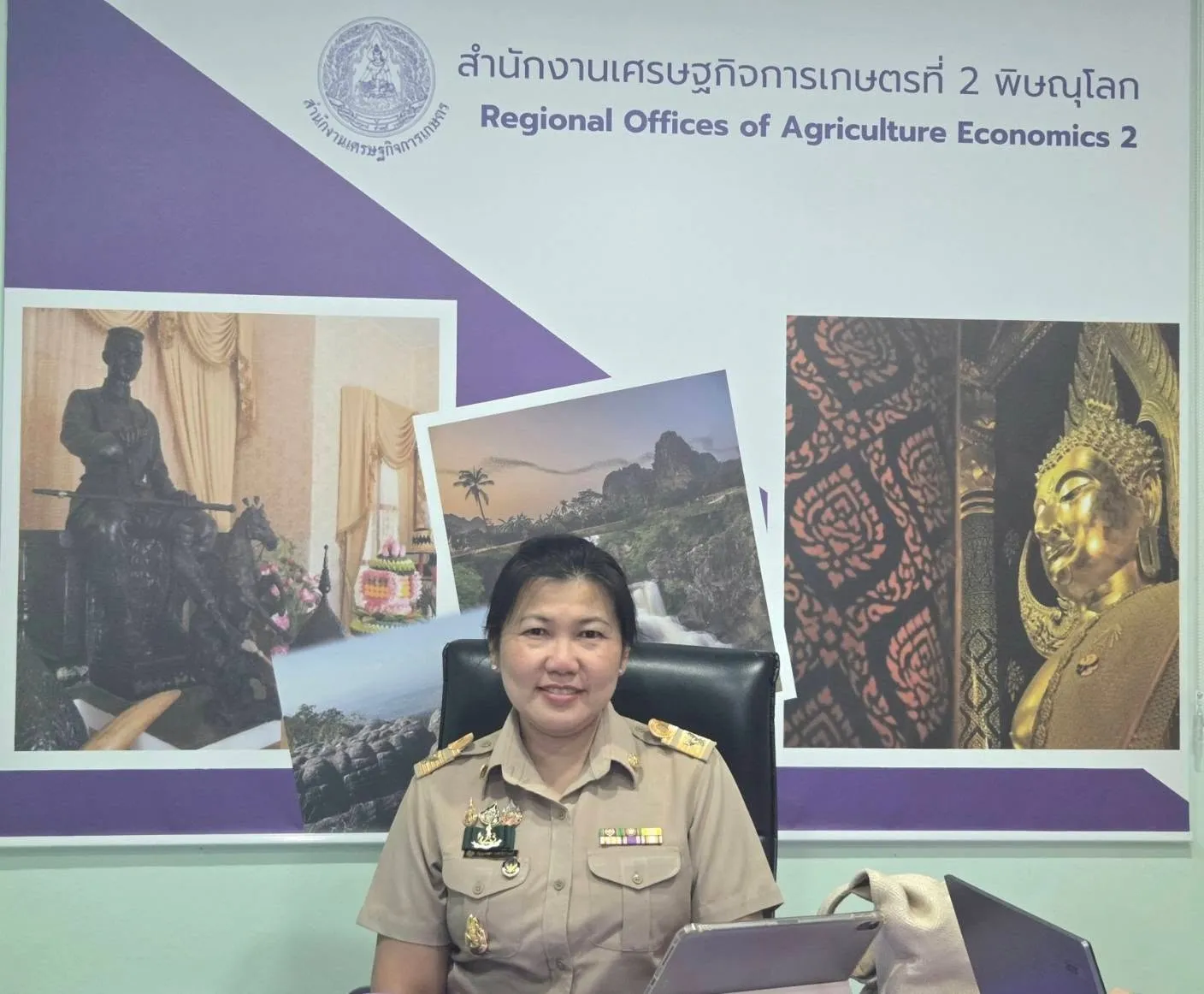
On November 2, 2026, Mrs. Thunphitcha Theraratchanon, Director of the 2nd Regional Office of Agricultural Economics (Director of ROAE2 Phitsanulok), accompanied by the Director of the Agro-Economic Research and Program Evaluation Division, convened the 6/2026 Staff Meeting of the Agro-Economic Research and Program Evaluation Division to track work progress, review operational plans, and assign tasks to personnel in preparation for driving operations under the Fiscal Year 2027 plan.
During the meeting, participants jointly reviewed operational performance, obstacles, and constraints, while discussing approaches to improve work processes. Emphasis was placed on integrating collaborative efforts among personnel and relevant divisions to advance key missions, including in-depth spatial agricultural commodity analysis, agro-economic situation analysis, and Rapid Rural Appraisal (RRA) surveys of major agricultural commodities. This involves linking primary field survey data with existing agro-economic datasets to ensure analyses accurately reflect real-world conditions, challenges, and constraints across local areas.
Furthermore, the meeting aimed to align operations with the ECON Policy Framework concept, which underscores systematic end-to-end collaboration: from problem identification, data collection design, and data quality verification, to analyzing production situations, costs, income, prices, and risks. It also encompasses synthesizing root causes and development opportunities to formulate localized policy solutions, presenting findings to executives and relevant agencies, and conducting monitoring and evaluation to continuously feedback insights into operational refinements.
Additionally, duties and responsibilities were assigned to personnel, highlighting the importance of systematic planning, task prioritization, shared data utilization, and inter-divisional coordination to eliminate redundancies and enhance operational efficiency. The objective is to ensure that agro-economic situation analyses and in-depth commodity evaluations effectively support strategic planning, policy intervention formulation, and local agricultural commodity management.
Photo/News: Public Relations Working Group, ROAE2 Phitsanulok