
In 1952 (B.E. 2495), a Royal Decree established the “Division of Agricultural Economics and Land” under the Office of the Permanent Secretary, Ministry of Agriculture, dividing its operations into two sections: the Land Use Section and the Research and Statistics Section.
In 1954 (B.E. 2497), a Royal Decree changed the name to the “Division of Agricultural Economics,” divided into three sections: the Production Economics Section, the Agricultural Statistics Compilation Section, and the Survey and Research Section.
In 1957 (B.E. 2500), a Royal Decree reorganized the Division of Agricultural Economics by establishing two additional sections: the Project Control Section and the Agricultural Product Analysis Section.
In 1972 (B.E. 2515), the Division of Agricultural Economics conducted studies and delineated agricultural economic zones utilizing various variables—such as soil types according to Great Soil Groups, rainfall distribution, temperature, cultivated crop types, average rice yield per rai, major commercial crops, and the proportion of farmers’ income in each province. Based on these variables, the country was divided into 19 zones called Agro-Economic Zones (AEZ). In the same year, a Revolutionary Council Announcement reorganized government agencies under the Office of the Permanent Secretary, Ministry of Agriculture, separating the “Project Control Section” from the Division of Agricultural Economics to elevate it to the “Planning Division,” alongside the formal demarcation of Thailand’s 19 Agro-Economic Zones.
In 1973 (B.E. 2516), the Cabinet resolved to establish the “Center for Agricultural Statistics” within the Division of Agricultural Economics, responsible for collecting all types of agricultural data.
In 1977 (B.E. 2520), an Order of the Ministry of Agriculture and Cooperatives reorganized the work and civil service/employee staffing within the Division of Agricultural Economics into four branches: the Agricultural Economics Coordination Branch, the Agricultural Policy and Planning Branch, the Agricultural Economics Research Branch, and the Center for Agricultural Statistics.
On March 24, 1979 (B.E. 2522), an Act was enacted elevating the Division of Agricultural Economics to the “Office of Agricultural Economics” under the Ministry of Agriculture and Cooperatives. A subsequent Royal Decree divided the internal structure of the Office of Agricultural Economics into six divisions: the Office of the Secretary, the Agricultural Development Policy and Planning Division, the Program Evaluation Division, the Planning Division, the Agricultural Economics Research Division, and the Center for Agricultural Statistics.
The term “Agro-Economic Zone” under the Agricultural Economics Act, B.E. 2522 (1979), refers to an agricultural production zone—including livestock farming and afforestation—designated to suit market conditions and Thailand’s agricultural economy, taking into account similarities among primary factors such as soil, climate, water sources, cultivated crops, livestock, farming types, and farmers’ principal income.
Later in 1983 (B.E. 2526), the Office of Agricultural Economics restructured its agro-economic zone operations by assigning personnel across all 19 zones under the direct command of the Secretary-General of the Office of Agricultural Economics. The objective of deploying staff to station at various zones, according to executive vision at the time, was to economize the budget incurred by dispatching central staff to regional areas and to serve as regional representatives of the Office, attempting to replicate the Office’s operational model within regional jurisdictions.
In 1987 (B.E. 2530), the Cabinet acknowledged the division of Agro-Economic Zones into 24 zones, as certain zones covered extensive geographic areas and demarcating 24 zones would facilitate smoother operations.
In 1996 (B.E. 2539), a Royal Decree reorganized the administrative structure of the Office of Agricultural Economics into two divisions and three bureaus: the Office of the Secretary, the Program Evaluation Division, the Center for Agricultural Information, the Bureau of Agricultural Development Policy and Planning, and the Bureau of Agricultural Economics Research.
In 2013 (B.E. 2556), three additional zones were established, forming the Regional Offices of Agricultural Economics Zone 1–12.
In 2014 (B.E. 2557), the regional demarcations were reorganized into 18 zones corresponding to official ministerial inspection areas as the Regional Offices of Agricultural Economics Zone 1–18, with an official opening ceremony held on July 1, 2014, and full operations commencing on October 1, 2014.
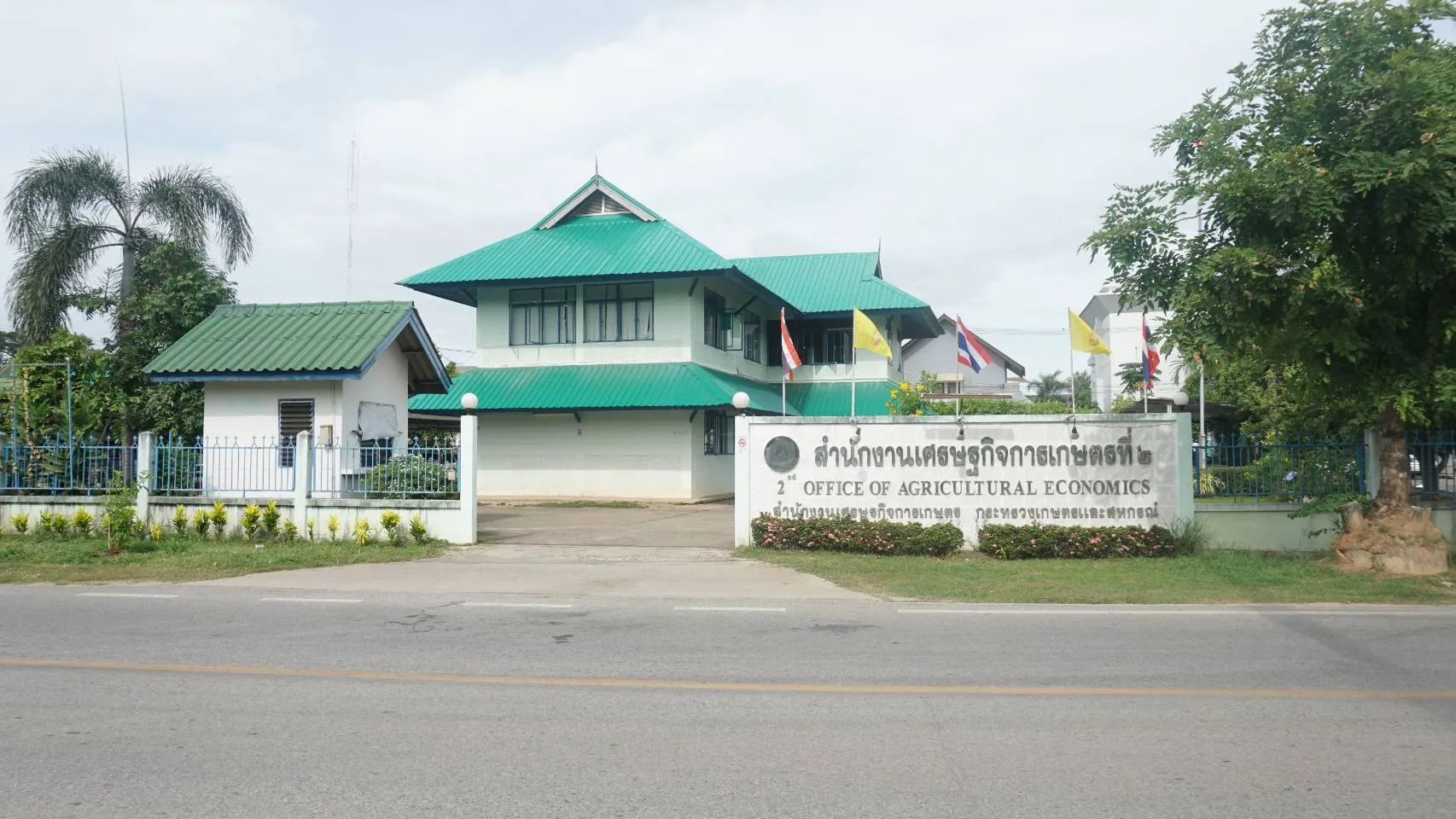
In 2015 (B.E. 2558), the agency was renamed the 2nd Regional Office of Agricultural Economics, retaining the same statutory duties and authorities.
In October 2016 (B.E. 2559), the areas were re-demarcated into the Regional Offices of Agricultural Economics 1–12.
Currently, the 2nd Regional Office of Agricultural Economics is responsible for the operational areas of Phitsanulok, Sukhothai, Tak, Uttaradit, Phrae, and Nan Provinces, with its primary office located in Phitsanulok Province.